
Responsible Gambling: Resources for Ice Fishing Players

Who Should Read This Page First?
| If you are... | Read this page? | Best next step |
|---|---|---|
| Playing longer than planned | Yes | Set a session timer |
| Chasing losses | Yes | Use stop-loss rules from strategy |
| Setting deposit limits | Yes | Use account limits before the next session |
| Feeling fine but cautious | Still useful | Read the warning signs once |
Responsible play long-tail angle: this page is for “Ice Fishing responsible gambling,” “Ice Fishing loss chasing,” “Ice Fishing session limit,” and “how to stop playing Ice Fishing.”
Ice Fishing runs at 8-second round intervals. That means in one hour you can place around 450 bets — which is a lot of exposure, especially if you're in a cold streak. This page exists because fast-pace games need fast-pace responsible-gambling awareness.
Why This Page Exists
The 8-Second Betting Window Is a Risk Factor
Short betting windows remove the natural pause between decisions. When you have 22 seconds between Monopoly Live rounds you have time to think about what you're doing and whether you should keep going. With 8 seconds on Ice Fishing, the next round is already starting before you've processed the previous one. This isn't intentional psychological manipulation on Evolution's part — it's a design choice for game pace — but the behavioural effect is real. Fast-pace games trigger loss-chasing at higher rates than slower-pace games.
Session Length Can Run Away From You
At 450 potential rounds per hour, a three-hour session is over 1,300 rounds. That's more action than a typical slot player gets in a full day. If each round is 4 units wagered (a modest hybrid spread), you're putting 5,400 units through the game in three hours — even at a 96% RTP that's 216 units of expected loss. For a player with a 100-unit bankroll, three hours is well past the point where losses should have triggered a stop.
Signs You May Have a Gambling Problem
Behavioral Signs
Playing longer than planned on a regular basis. Chasing losses after a cold streak by raising stakes. Lying to family or friends about how much time or money you're spending on gambling. Feeling anxious or irritable when not playing. Playing to escape problems rather than for entertainment. Ignoring work, relationships, or personal health because of gambling.
Financial Signs
Borrowing money to gamble. Selling possessions to fund gambling. Missing bill payments because gambling has consumed available funds. Hiding financial losses from people who would be affected. Using credit cards to fund Pin Up deposits when you can't afford the monthly credit payment.
If any of these feel familiar, you're not alone and there's free help available. The helplines further down this page are genuinely free and genuinely anonymous.
Setting Deposit and Loss Limits on Pin Up
Daily, Weekly, and Monthly Caps
Pin Up lets you set daily, weekly, and monthly deposit caps that hard-stop further deposits once reached. These are enforced at the operator level so you can't work around them by topping up from a second payment method — the cap applies to the account, not the payment. I strongly recommend setting a weekly cap before you start playing Ice Fishing. Pick a number you can afford to lose entirely and set that as the weekly limit.
How to Set Them
Log into Pin Up, open your account settings, find the "Responsible Gambling" or "Limits" section. You'll see options for deposit limits, loss limits, wager limits, and session time limits. Fill in the numbers you want and confirm. Pin Up requires a 24–48 hour cooling period before you can increase a limit (the delay exists specifically to prevent in-the-moment limit raises), but you can lower a limit immediately.
Session Time-Out and Cooling-Off on Pin Up
Time-Out Periods
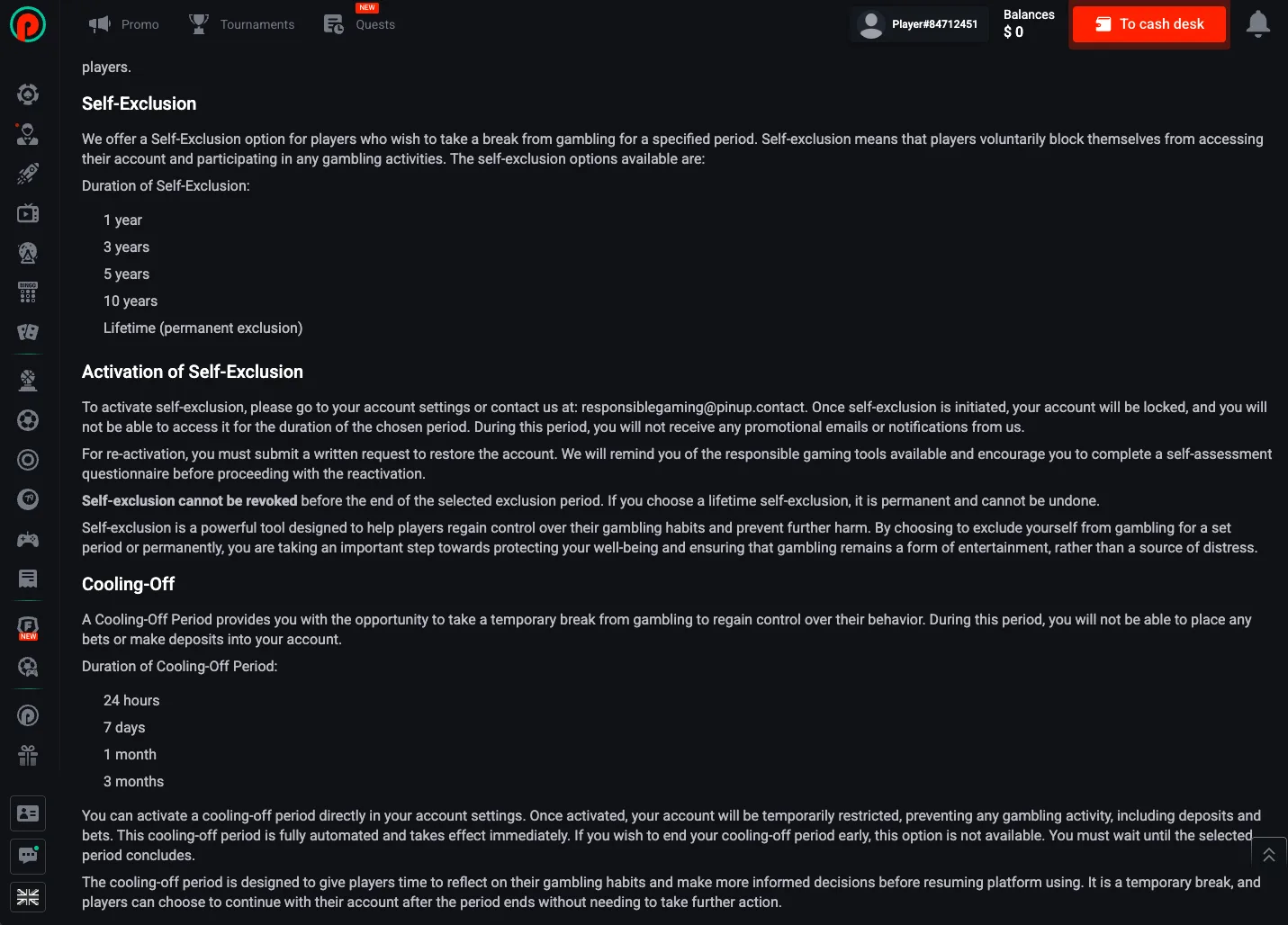
Session time-outs let you block yourself from the account for a set period — 24 hours, 7 days, 30 days, or 6 months. During the time-out you can't log in, can't deposit, and can't play. This is useful if you feel yourself slipping into problem patterns but don't yet want a permanent self-exclusion. It's lower-commitment than the full self-exclusion process and takes effect immediately.
Self-Exclusion Process
Self-exclusion is the stronger version. You ask Pin Up to block your account permanently (or for a set period of years). Once activated, self-exclusion is extremely hard to reverse — you'll need to go through a formal review with Pin Up support, which usually requires waiting the full exclusion period. This is deliberately high-friction because it's intended for players who genuinely need to stop playing entirely.
Helplines by Region
BeGambleAware (Global)
Free, confidential support and counselling across multiple countries. Web chat and helpline.
begambleaware.orgGamCare (Global)
Free helpline and online tools. 24/7 support via phone, web chat, and forum.
gamcare.org.ukiCall (India)
Free psychosocial support in English, Hindi, and several regional Indian languages.
icallhelpline.orgJogadores Anônimos (Brazil)
Gamblers Anonymous meetings and peer support across Brazil. Portuguese language.
jogadoresanonimos.com.brGambling Therapy (EU)
Free online support, group sessions, and one-on-one counselling across Europe.
gamblingtherapy.orgFast-Pace Games and Variance Awareness
Ice Fishing's 8-second window is the single most relevant fact for responsible gambling on this specific game. When you compress decision-making time, you reduce the natural checkpoints that let you notice "I've been playing for longer than I meant to" or "I've lost more than I can afford." The compensating behaviour is to pre-commit to session rules — stop-loss, take-profit, time cap — before you start playing, and to treat those rules as non-negotiable once set.
This isn't scolding. It's math. A 450-round hour is an intense exposure and treating Ice Fishing like a slow slot session will hurt your bankroll. The strategy page covers bankroll math in detail, including the 40-unit minimum and the 40/80 stop-loss/take-profit ratio I use personally. The math applies even more strongly when the game runs as fast as Ice Fishing does.
What Ice Fishing players should do differently
Fast games need pre-committed rules, not in-session discipline. If you wait until a streak is happening to decide what your stop-loss should be, you are already too late. The most practical rule set for Ice Fishing is boring on purpose: fixed stake size, fixed stop-loss, fixed session timer, and no “one more bonus round” exception. The game is fast enough that one emotional exception can turn into fifty extra bets before you really notice it.
I also recommend separating analysis time from play time. If you want to study multipliers, open multiplier history when you are not logged in and not funded for a session. If you are funded and emotional, data pages can become rationalization tools instead of learning tools. On a game this fast, that distinction matters a lot.
Practical Guardrails
| Guardrail | Set it before play | Why it helps |
|---|---|---|
| Deposit cap | Yes | Prevents topping up during a bad run |
| Session timer | Yes | Removes “just one more round” drift |
| Stop-loss | Yes | Stops loss-chasing early |
| Take-profit | Yes | Helps you leave while ahead |
Where to Get Support Now
If you're struggling during reviewed sessions, pick any of the helplines in the grid above and reach out. All are free, confidential, and staffed by people trained to help. You don't need to commit to anything beyond the phone call or chat — you can just talk. If you're not struggling but want to reduce your Ice Fishing exposure, set a weekly deposit cap on Pin Up before your next session. It takes two minutes and it's the single most effective thing you can do.
For the rest of the site: home, strategy and bankroll rules, FAQ including account safety questions.