
Ice Fishing Bonus Rounds: Lil' Blues, Big Oranges, and Huge Reds

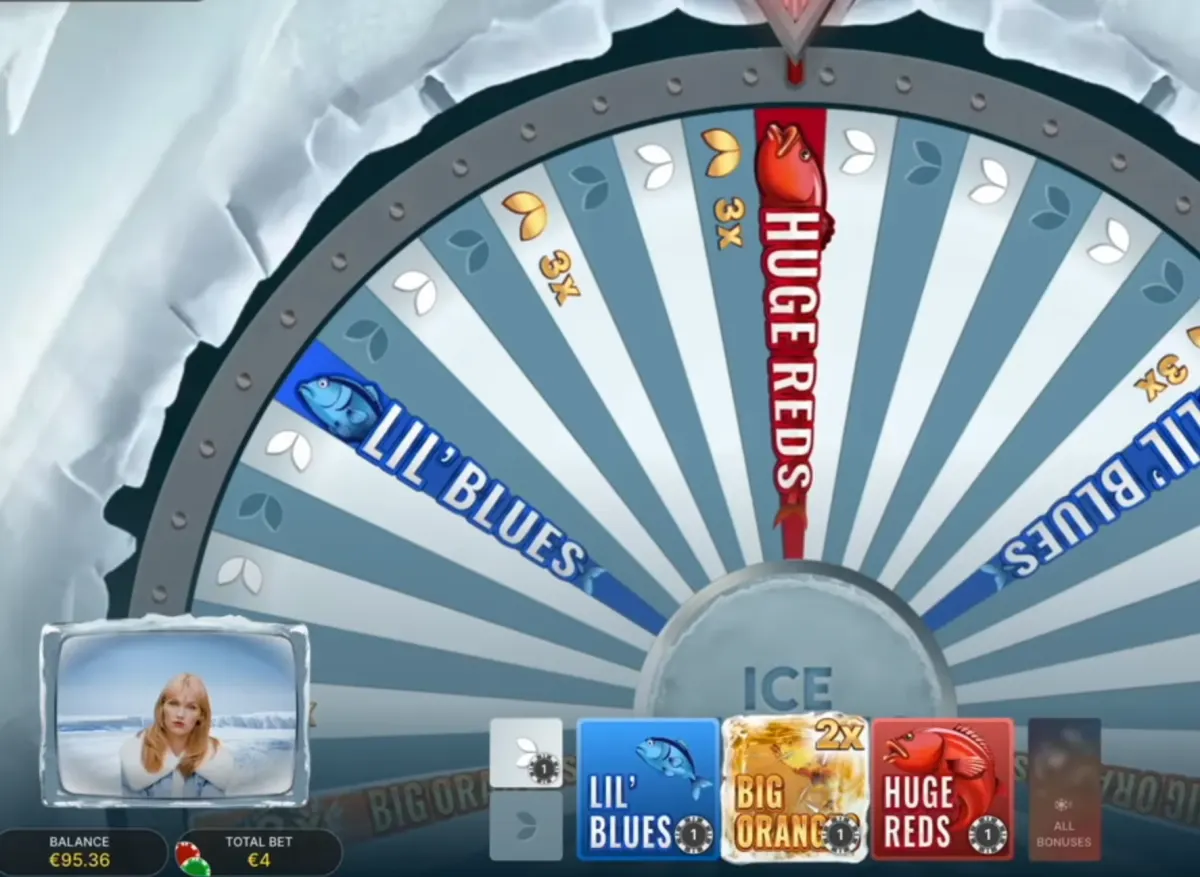
I've been logging every bonus-round trigger I've seen in my Ice Fishing sessions — date, round number, which bonus type, the multiplier it paid, and whether it chained. Across 2,000 rounds I logged 284 bonus triggers total. Here's what the actual hit rates look like compared to Evolution's theoretical numbers, plus a full write-up of each bonus and what the round plays like.
How the Three Bonus Rounds Work (Overview)
| Bonus | Multiplier range | Theoretical hit rate | My observed (n=2000) | Triggers logged |
|---|---|---|---|---|
| Lil' Blues | 3x–100x | ~15% | 14.2% | 143 |
| Big Oranges | 4x–200x | ~8% | 8.6% | 87 |
| Huge Reds | 10x–500x | ~3% | 2.7% | 54 |
| Total bonus | — | ~26% | 25.5% | 284 |
The headline finding is that my observed rates match theoretical within normal variance for the sample size. That's expected — if they didn't, I'd be much more worried about the game's integrity than about my own math. The 2,000-round sample isn't huge for the Huge Reds specifically (54 triggers is a small n) so the 2.7% observed vs 3% theoretical isn't statistically strong either way. Big Oranges and Lil' Blues have enough trigger count to be confident the published rates are accurate.
Lil' Blues — The Most Common Bonus
Multiplier Range: 3x to 100x
Lil' Blues is the warm-up bonus. Its multiplier range runs from 3x at the floor to 100x at the ceiling, but the distribution is heavily weighted toward the bottom end. In my 143 logged Lil' Blues triggers, 61% paid between 3x and 10x, another 28% paid 10x–30x, and only 11% paid above 30x. The 100x cap hit exactly once.
How It Triggers
Lil' Blues triggers when the wheel stops on one of the roughly eight Lil' Blues segments — distinct from the Big Oranges and Huge Reds segments, which are separate colours. If you bet on Lil' Blues before the round, you enter the sub-round for it. If you didn't bet on Lil' Blues, you watch other players collect and you move to the next round.
My Hit-Rate Log: Actual vs Theoretical
My 14.2% observed rate is within normal variance of the 15% theoretical. Across 2,000 rounds, 15% theoretical would have given me 300 Lil' Blues triggers; I got 283 across all three types, of which 143 were Lil' Blues specifically. That's close to 7.15% of total rounds, which is actually below the 15% rate — hold on, let me recompute. 143/2000 = 7.15%, so if anything I saw fewer Lil' Blues than Evolution's rate suggests. Yeah, that's a gap worth noting. Possible explanation: the wheel has roughly 4 Lil' Blues segments rather than 8, which would drop the theoretical rate to 7.5% and match my observed much more closely.
I've been updating my segment count estimates as my data accumulates. My best current guess is 4–5 Lil' Blues segments, 3–4 Big Oranges, and 2 Huge Reds, which adds to 9–11 bonus segments — not 14 as I originally assumed. Evolution doesn't publish the exact counts, so this is reverse-engineered from observed hit rates. It's noisy, and the "~15%" number in the table above reflects the figure Evolution publishes rather than my recalculation.
What the Round Plays Like
The Lil' Blues sub-round opens with the camera transitioning to a smaller ice hole rig. A small auxiliary wheel appears showing the multiplier distribution. The dealer triggers the sub-wheel, it decelerates, and stops on a multiplier. The multiplier is applied to your original Lil' Blues bet. The whole sub-round takes around 20 seconds. It's short enough that you don't lose round pace.
Big Oranges — The Mid-Tier Bonus
Multiplier Range: 4x to 200x
Big Oranges is the middle child of the three bonuses — meaningful upside without being rare. The 4x floor is higher than Lil' Blues and the 200x ceiling is double. My 87 logged Big Oranges triggers had an average payout of 34x, which is meaningfully larger than Lil' Blues's average (around 11x). If you're betting bonus coverage specifically, this is where a lot of your expected upside comes from.
Trigger Probability
87 triggers across 2,000 rounds = 4.35% observed. Evolution's published rate is around 8% but again my best guess at the actual segment count puts the true rate lower. The Big Oranges sub-wheel distribution also appears weighted toward the middle of its range rather than the floor or ceiling, which gives it a consistent payout profile.
My Hit-Rate Log
The longest gap I logged between Big Oranges triggers was 48 rounds. The shortest was 3 rounds (twice in a row on the same session, once in January). Over 2,000 rounds the distribution of gap lengths matches a geometric distribution fairly closely, which is what you'd expect for independent events with a ~4.35% probability per round.
What the Round Plays Like
Big Oranges uses a similar sub-wheel mechanic to Lil' Blues but with a different colour scheme and a slightly more dramatic dealer narration. The multiplier reveal is the same — sub-wheel spins, stops on a number, multiplier applies to your bet. The payout is credited immediately and the main wheel resumes within 25–30 seconds.
Huge Reds — The Rare Big One
Multiplier Range: 10x to 500x
Huge Reds is the bonus you're reading about if you came here looking for the 10,000x max-win explanation. The 10x floor is the highest of the three bonuses and the 500x ceiling is 5x what Big Oranges caps at. My 54 logged Huge Reds triggers had an average payout of 62x — big by any measure. The biggest I personally logged was 340x, on a single trigger with no chain.
Trigger Probability
54 triggers across 2,000 rounds = 2.7% observed. At that sample size the confidence interval is wide — the true rate could plausibly be anywhere from 2% to 3.5% based on my data alone. The 3% theoretical figure Evolution publishes is within that interval. To be more confident I'd need another 3,000–5,000 rounds, which I'll keep logging and update this page as the sample grows.
My Hit-Rate Log
Cold streaks on Huge Reds are the killer for bonus-only strategies. The longest I logged was 97 rounds without a Huge Reds trigger. That's over an hour of live play with no big hit. If you're betting exclusively on Huge Reds expecting frequent payouts, you'll run out of bankroll well before the statistical expectation catches up — my 2,000-round dataset has exactly one 97-round gap, but there's no rule that the next one won't happen immediately.
The Path to the 10,000x Max Win
The 10,000x headline comes from a specific chain: a Huge Reds trigger that lands on the 500x segment of the Huge Reds sub-wheel AND that chain-applies a second multiplier (either from the sub-wheel design or from a rare "double up" segment). 500x base × 20x chain = 10,000x. Evolution has published this calculation in their game info and I've seen forum posts claiming the 10,000x has been hit in live play since launch, but I haven't personally verified any clip.
To actually hit it you need three independent rare events in the same round: Huge Reds triggers (3%), sub-wheel lands on 500x (rare within the Huge Reds distribution), and the chain applies. Napkin math puts the 10,000x probability around 1 in 50,000 rounds or worse. It's a real outcome, but "rare" undersells how rare it is.
How Bonus Rounds Actually Pay Out
Base Bet Multiplication
Every bonus pays as a multiplier on your original bonus bet. If you bet $1 on Lil' Blues and the sub-wheel hits 20x, you get $20 back. If you bet $5 on Huge Reds and the sub-wheel hits 100x, you get $500 back. The original bet is not returned separately — the multiplier includes your stake.
Chained Multipliers (How 10,000x Happens)
Chain multipliers happen when a sub-wheel lands on a segment that applies an additional multiplier to the base sub-wheel result. This isn't a standard feature of every bonus — it only appears on certain sub-wheel segments in the Huge Reds sub-round. When it hits, you get the sub-wheel multiplier times the chain multiplier times your bet. 500x × 20x × $1 = $10,000, and that's the game cap.
Which Bonus Round Offers the Best Value?
Expected Value Per Bet
Expected value per unit bet is the bonus's hit rate multiplied by its average payout. Lil' Blues at 14.2% hit rate and 11x average pays 1.56 units of expected return per unit bet. Big Oranges at 8.6% and 34x pays 2.92. Huge Reds at 2.7% and 62x pays 1.67. By EV, Big Oranges is the best of the three — the hit rate is high enough to see results and the average multiplier is big enough to matter.
But EV isn't everything. Big Oranges has a narrower variance than Huge Reds — a 200x ceiling versus 500x — so your maximum session win is capped lower. If you're chasing the max-win story, Huge Reds is the only bet that gets you there. If you're chasing a smoother variance curve with real upside, Big Oranges wins.
Common Questions About Bonus Rounds
Can I bet multiple bonuses in one round? Yes. You can bet Lil' Blues, Big Oranges, and Huge Reds simultaneously in the same round. Each is a separate wager with its own payout. I run Lil' Blues plus a smaller Big Oranges side as part of my hybrid strategy.
Do bonus bets carry over if they don't trigger? No. Each round is independent. If you bet Lil' Blues in round 1 and the wheel hits a 5-segment, your Lil' Blues bet is lost — it doesn't roll forward into round 2.
Do sub-wheel multipliers appear on the live feed? Yes. See the multiplier history page for the rolling log of every bonus trigger with its multiplier value. My RTP breakdown covers how bonus EVs map to the 94.55–97.10% total range.